CASE STUDY
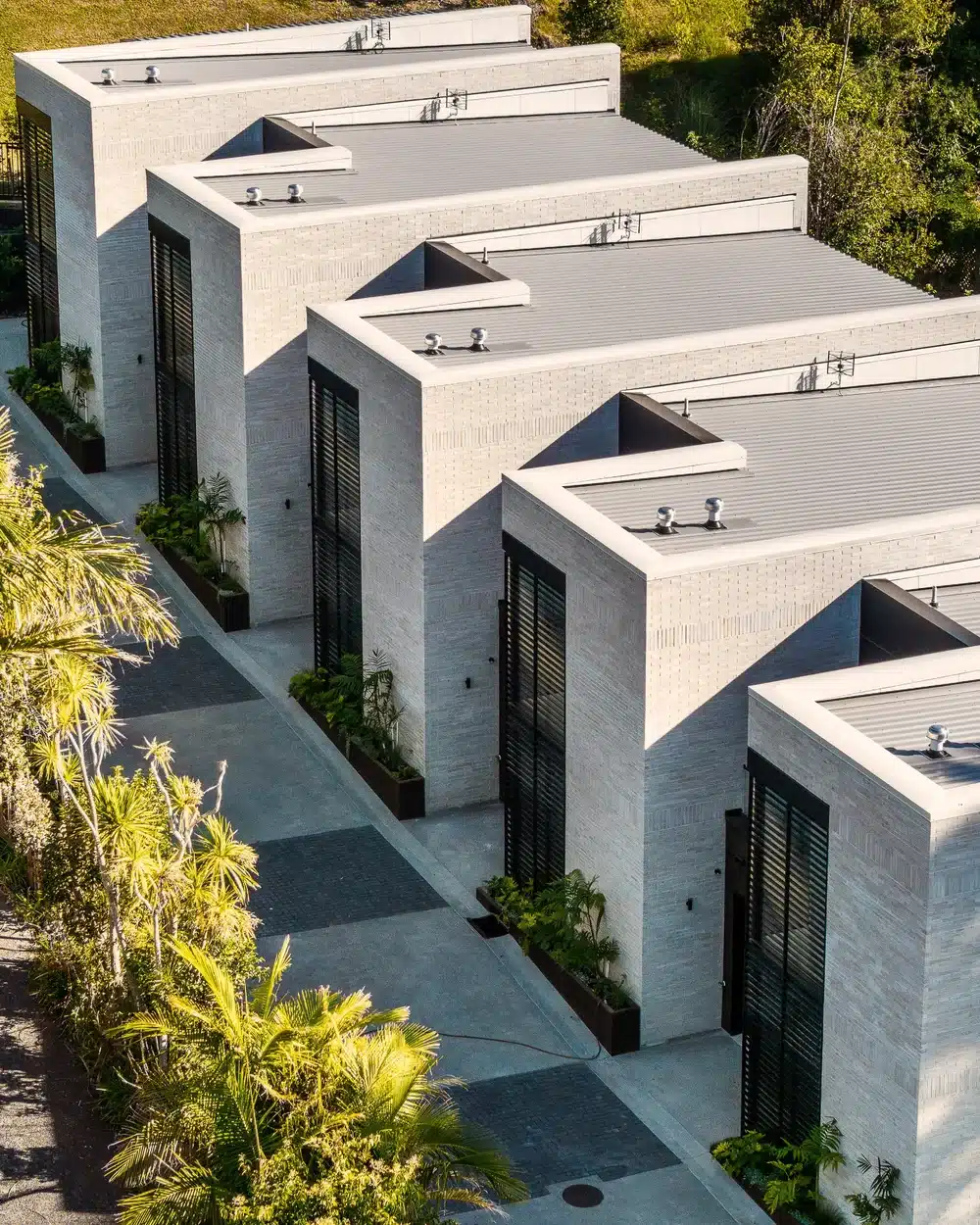
Arahia is a five-townhouse development on a compact urban site, requiring precise coordination between architectural intent, spatial efficiency, and regulatory performance. The design comprises two-level white bagged brick volumes stepping up the site, with interstitial garages providing clear articulation between units while supporting privacy and rhythm along the façade. Dense landscaping reinforces separation between dwellings and circulation zones. Central to the project was the performance of the intertenancy walls, which needed to meet fire, acoustic, and spatial requirements without adding construction complexity or compromising internal floor area.
- Year: 2025
- Location: Auckland
- Client: Contexture
- Market Segment: Intertenancy Apartment Systems
- Product Used: 51mm Galv Panel
- Architect: Monk Mackenzie
- Main Contractor: McCORE Group Ltd
The Challenge: Intertenancy Performance Without Compromise
As with many terraced housing developments, intertenancy walls at Arahia needed to achieve more than structural separation. The walls were required to:
- Meet stringent fire resistance requirements for attached dwellings
- Deliver strong acoustic performance to support quiet, comfortable living
- Be space-efficient, preserving valuable internal floor area
- Integrate seamlessly with a modern construction programme
Meeting all of these criteria within a compact building envelope demanded a system that was robust, compliant, and efficient to install.
KOROK® Intertenancy Solution
KOROK supplied 290m² of KOROK® 51mm Galv Panels, installed as part of the KOROK® Intertenancy Terraced Housing System.
The system delivers a -/60/60 Fire Resistance Rating, suitable for intertenancy walls in terraced housing and fully compliant with the New Zealand Building Code (NZBC). Unlike conventional framed and lined systems, the KOROK® panel itself forms the primary fire barrier, providing inherent durability and long-term resilience.
Panels are positioned between double wall frames and connected via aluminium brackets engineered to respond predictably in fire conditions—allowing the fire-exposed side to detach while maintaining the integrity of the barrier on the protected side.
KOROK® for Modern Terraced Housing
The Arahia project demonstrates how KOROK® Intertenancy Systems are well suited to contemporary townhouse developments—where protection, performance, and efficiency must coexist. By combining engineered fire resistance, acoustic control, and slimline design, KOROK continues to support safer, smarter, and more liveable medium-density housing across New Zealand.