As the construction industry works to reduce embodied carbon, much of the conversation focuses on selecting lower-carbon materials. While material choice certainly matters, one of the biggest opportunities often comes much earlier in the process: designing buildings that simply require less material.
Recent industry discussion, including BRANZ’s work on Whole of Product Thinking, reinforces this shift in thinking. Embodied carbon isn’t just determined by what products are made from—it’s also influenced by how much material is needed to deliver the required performance. At KOROK, reducing material demand begins with smarter system design.
Simpler systems, lower carbon
Traditional wall assemblies are often built from multiple layers and components, requiring additional framing, linings, fixings and extensive on-site work to achieve fire and acoustic performance. KOROK simplifies this process by integrating fire and acoustic performance into a single tested wall system. With fewer components required, projects consume less material from the outset.
This not only simplifies construction but also reduces the embodied carbon associated with manufacturing, transporting and installing those materials.
Sometimes the most effective way to reduce carbon is simply to build with less.
Manufactured to fit
Material efficiency doesn’t stop with system design.
Every KOROK panel is manufactured to the dimensions required for each project. Producing panels to the correct size minimises off-cuts, reduces over-ordering and significantly decreases on-site waste.
Unlike traditional construction, where materials are frequently cut and discarded during installation, made-to-measure manufacturing ensures that only the material required for the project is produced and delivered.
The result is a more efficient construction process with less waste sent to landfill and fewer resources consumed overall.
Efficiency beyond installation
Reducing material demand also improves efficiency throughout the construction process.
Fewer components mean fewer deliveries, less handling on site and faster installation, reducing the resources needed to complete each project. By simplifying the wall assembly, contractors spend less time managing materials and more time delivering completed spaces.
These efficiencies may not always be visible, but collectively they contribute to lowering the environmental footprint of a project.
Designed for long-term performance
Lower embodied carbon isn’t just about the day a building is completed.
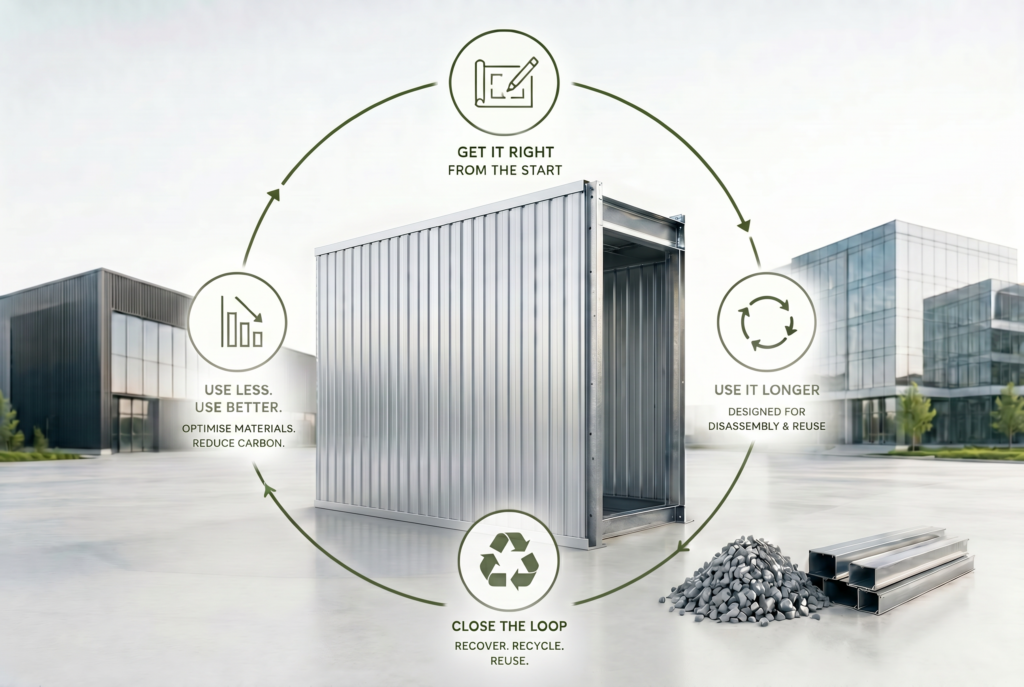
KOROK wall systems are designed for durability and long service life, helping reduce the need for replacement over time. Where appropriate, panels can also be removed and reused in future projects, extending their useful life and reducing demand for new materials.
At the end of their service life, the steel and concrete components can be recovered and recycled, supporting a more circular approach to construction.
Smarter design delivers lower embodied carbon
Reducing embodied carbon is rarely achieved through a single decision. It comes from making better choices throughout the design and construction process.
For KOROK, that means:
- Simplified wall systems that use fewer materials.
- Made-to-measure manufacturing that minimises waste.
- Reduced on-site cutting, handling and over-ordering.
- Lower embodied carbon through reduced material demand.
- Durable systems designed for long-term performance and recyclability.
As the industry continues to embrace whole-of-product thinking, one principle remains clear: the most effective carbon reduction strategies often begin by asking a simple question—how can we achieve the same performance using less? Designing smarter, manufacturing more accurately and reducing unnecessary material use creates buildings that are more efficient, more sustainable and better prepared for the future. To explore the broader industry perspective, read the BRANZ article: “Carbon reduction begins with whole of product thinking.”